
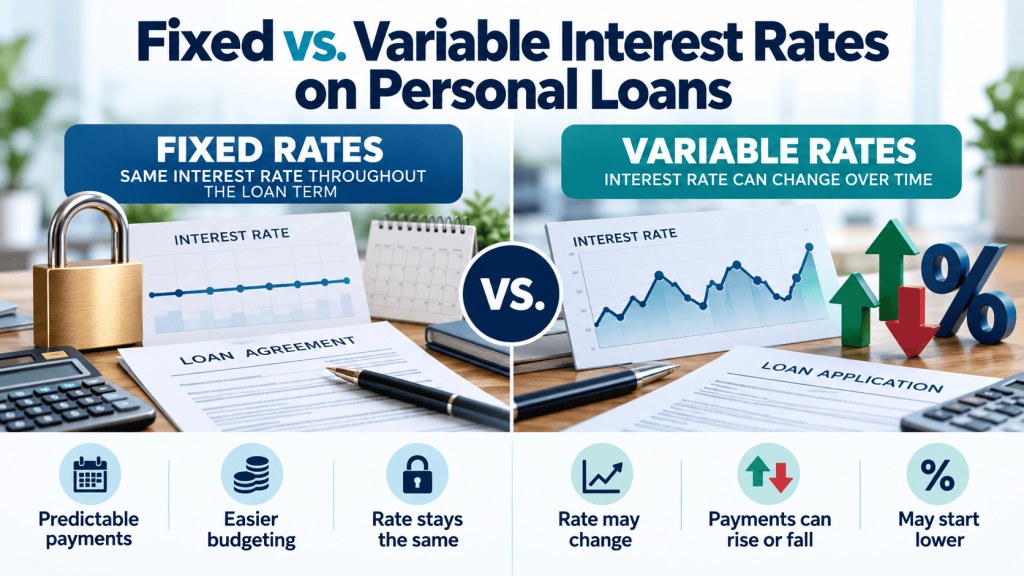
Understand payment predictability, rate-reset risk and how to choose terms that fit your finances. A personal loan can help finance a necessary expense or replace several debts with a scheduled installment, but the wrong loan can strain a household for years. The most useful question is not simply whether you qualify. It is whether the agreement supplies the money you actually need, at a cost you understand, with a payment you can keep making when life becomes less predictable. This guide is written for readers in the United States, where loan products and state-level requirements can differ. It is educational information, not a personal recommendation or a lender endorsement.
Quick Answer: The Most Important Decision
Fixed vs. Variable Interest Rates on Personal Loans is ultimately about balancing an understandable borrowing cost with manageable risk. Compare the amount needed, repayment schedule, total dollars paid and conditions in the lender disclosure. A lower advertised number should never outrank the terms that actually govern your obligations. Use the sections below as a decision framework rather than as a list of guaranteed outcomes.
The Consumer Financial Protection Bureau describes a personal installment loan as a fixed-sum borrowing arrangement repaid through installments and cautions that fees can affect the amount ultimately paid. The Federal Trade Commission warns about advance-fee loan scams that promise guaranteed credit for money paid first. These are useful checkpoints when an online advertisement seems unusually attractive. A company offering financing should be evaluated using the actual contract and independent verification, not testimonials alone. In practice, this means making a modest set of well-chosen comparisons instead of applying to every lender that advertises an attractive rate. Keep copies of disclosures, identify uncertainties and pause if a fee or qualification rule remains unclear.
Step-by-Step Guide: What to Examine
1. Define fixed interest
A fixed interest rate generally remains constant during the agreed term, making budgeting easier when the loan also uses a stable installment schedule. As you review this issue, distinguish the contractual promise from the outcome you hope for. An advertised benefit may depend on eligibility, payment history, timing or other conditions. Those details matter more than a headline claim and deserve a line of their own in your comparison notes.
For an everyday example, imagine that a household has an appliance replacement to fund while also paying rent, utilities and a car note. The borrower first writes down the essential expense, then checks the loan condition described above against an actual monthly cash-flow calendar. That makes the choice tangible: a favorable-looking offer is only valuable if it remains manageable on the dates when other bills arrive.
2. Define variable interest
A variable rate can change according to a specified benchmark and lender margin. The agreement determines adjustment dates, limits and what happens to payments. A useful way to test the idea is to write two columns: the best reasonable outcome and an inconvenient but plausible outcome. Estimate whether your budget could absorb the second one. When a decision remains affordable only under perfect conditions, the underlying obligation may be too fragile.
Suppose two lenders describe similar loans using different promotional language. Rather than choosing the lender with the largest discount headline, compare the written terms side by side. Record how this particular issue changes the cash received, amount owed, payment timing or consequences of missed payments. Those are measurable differences, unlike a claim that an application is ‘easy.’
3. Read the benchmark rule
Ask what external rate or index drives adjustments, how often it is measured and whether the lender has discretion over the margin. Before acting, ask the lender to identify the exact provision in its written agreement that addresses this subject. Save the document and the date you received it. A verbal summary from a sales representative is less useful than wording you can revisit when a billing problem arises.
Consider a worker with variable hours. In a busy month, a proposed payment looks comfortable; in a slower month, it competes with groceries and transportation. Applying the principle here means stress-testing the same contract under the lower-income month. A responsible decision should survive more than one optimistic paycheck.
4. Understand caps and floors
Some agreements limit changes; others may have different restrictions. A cap on interest rates is not necessarily a cap on total borrowing cost. For a practical comparison, keep unrelated variables constant. If you change the loan amount, term and fee structure at the same time, it becomes difficult to tell which change explains the result. Change one assumption first, then examine the complete offer again.
Imagine a borrower reviewing an offer on a phone during a lunch break. Key conditions may sit in a disclosure attachment rather than on the advertising page. The safer sequence is to download that document, locate the relevant clause, and compare the numbers after work rather than agreeing before the full cost and obligations are visible.
5. Model a rising-rate scenario
Calculate affordability if a variable borrowing rate increases by two or more percentage points. This is a stress test, not a forecast of interest rates. This choice interacts with other household priorities. Rent, food, utilities and existing obligations still arrive even when a borrowing option looks attractive. Put the estimated payment on the actual calendar and check the weeks when several bills fall due.
A family may have cash savings but want to preserve an emergency reserve. That creates a legitimate comparison between using cash now, borrowing a smaller amount, or delaying part of the expense. The issue described in this section can shift which option is reasonable; it should be evaluated together with liquidity, not as an isolated percentage.
6. Model falling-rate potential
Variable loans may become cheaper if the reference rate declines and contract rules pass that movement through. Do not budget as though a decrease is certain. There is also a behavioral component. A borrower may understand the math and still struggle when the payment plan requires constant attention. Choose a system of reminders, automatic transfers or written checkpoints that you can realistically maintain.
A borrower who expects to repay early should not automatically select a contract designed around the lowest monthly installment. Check whether early payments are accepted, how they are credited and what fees remain. The timing of cash flows can change the practical value of the condition discussed here.
7. Compare starting APRs
A lower initial variable APR may look attractive, but compare the fixed offer with at least one realistic higher-rate outcome and the total cost. Think about how the decision would be explained to someone who shares household expenses with you. If you cannot describe the costs, conditions and exit options in plain language, collect more documentation before committing. Clarity is part of financial risk control.
A straightforward notebook works as well as sophisticated software. For each lender, write the actual term, amount received, amount financed, monthly due date, and what the agreement says about this issue. If a question cannot be answered from the document, request clarification before the loan is finalized.
8. Consider loan length
Interest-rate uncertainty accumulates over time. A very short loan and a long loan can expose the borrower to different amounts of potential adjustment risk. Do not confuse a lender’s willingness to extend credit with a conclusion that the loan is inexpensive. Underwriting measures repayment risk from the lender’s perspective; your own budget must account for spending priorities and the possibility of income interruptions.
Think of a loan quote as a set of linked choices rather than a single number. A change to one feature can affect risk, interest, fees or flexibility elsewhere. Reviewing the topic here means asking what else must change in the offer for the comparison to remain fair.
9. Consider stable income
Households with little monthly spare cash may value predictable payments more than uncertain savings. This is a budgeting preference, not a universal best rate choice. Set a review date rather than relying on memory. Save the offer, record the relevant numbers, and note what would make you reconsider. The review is especially valuable after a credit change, new financial obligation or unexpected expense.
A borrower could be approved for more than planned, but the extra credit should not become the new spending target. Start with the smallest amount that meets the real need, then apply the relevant cost or protection check. Approval limits reflect lender decisions, not a personal savings goal.
10. Review early payoff and refinancing
Check whether prepayment is allowed without penalty and what refinancing would actually cost. Refinancing is not guaranteed and may depend on future credit and market conditions. Be cautious about comparing information from different years or jurisdictions. Consumer protections and contract terms can vary by state and product. If a detail is material to your decision, verify it using the current agreement and an authoritative regulatory source.
A loan can also become expensive through avoidable administrative mistakes. Keep the disbursement notice, payment schedule, lender contact details and any messages about changes. That record makes it easier to recognize when charges or instructions differ from what was agreed.
11. Read payment-change notices
If rate changes are allowed, understand when the lender must communicate new terms and how to check each statement for accuracy. A strong plan specifies who will perform the next action and when. Whether the task is requesting a disclosure, reviewing a statement or checking a payment date, give it a concrete deadline. Small administrative mistakes can create avoidable borrowing costs.
In a couple or shared household, repayment affects more than the named borrower. Explain the commitment in clear numbers and show how this particular loan feature would work if income dropped temporarily. Shared understanding helps avoid a payment plan that relies on hidden assumptions.
12. Choose based on downside capacity
A decision is not only about which offer is cheaper today but whether you could continue paying if an adverse scenario occurs. Finally, compare the cost of doing nothing with the cost of borrowing. If an expense can safely wait, saving for part of it may reduce principal and interest. If it cannot wait, a documented, affordable plan still beats a rushed decision based on advertised speed.
If the terms are difficult to interpret, ask a specific written question rather than accepting a broad reassurance. For example, request a sample calculation or identify the exact contract paragraph governing the matter. A lender’s response can help you decide whether the offer is transparent enough to evaluate.
A Worked Loan Budget Example
Consider a hypothetical borrower who needs $8,000 and receives a fixed-rate offer at 12% nominal annual interest for 36 monthly payments, with no added fees. Under a standard monthly amortization model, the payment is about $265.71, scheduled payments total about $9,565.72 and total interest is about $1,565.72. This is a teaching example, not a current market quote. Actual lender schedules may vary because of payment dates, rounding, interest conventions and fees.
Now imagine a second offer with the same principal and nominal rate but a 5% upfront origination fee deducted from proceeds. The borrower might receive just $7,600 although payments are based on $8,000. If the expense costs $8,000, that quote does not fully fund it. A comparison of the payment alone hides the gap. A proper comparison requires the APR disclosure, cash received, total finance charge and final amount owed.
The borrower also reviews take-home income of $3,600, essential monthly costs of $2,550 and other debt payments of $350. Before the proposed loan, $700 remains for discretionary spending, reserves and irregular expenses. After a $265.71 payment, roughly $434 remains. That might be feasible for one household and too tight for another. An insurance renewal, a medical copay or a lower-work-hours month could change the calculation quickly.
These examples teach a sequence: calculate the real amount needed, read the final offer, model the full payment schedule, and then test the payment against ordinary and difficult months. Do not borrow additional principal simply to make a lender advertised promotion qualify. The smallest sustainable loan frequently deserves more attention than the largest available approval.
How to Compare Offers Without Losing Important Details
Create a worksheet with one row per offer and fields for requested principal, cash disbursed, nominal interest rate, disclosed APR, fixed or variable rate, number of payments, scheduled monthly amount, total of payments, upfront charges, optional extras, late-fee rules and prepayment treatment. Include a field for how the lender verified your income or credit, and whether the estimate is conditional. If one field is missing, mark it as missing rather than assuming zero.
Evaluate affordability separately from price. A lower APR can be more economical in total, but the related monthly amount may be uncomfortable if repayment is accelerated. A longer term may lower the payment while increasing total borrowing cost. Match the term to both your near-term cash flow and the date when you would like to be debt-free. Run your spreadsheet with a reduced-income assumption and an unavoidable extra bill.
After you identify a promising offer, verify the lender through official channels. Search the state financial regulator or banking authority where appropriate, confirm the correct website domain, and never rely exclusively on a referral link or social media account. Be particularly cautious about any party that promises approval without examining creditworthiness and demands a payment to release funds. The FTC specifically identifies this pattern as a warning sign.
Common Mistakes to Avoid
- Comparing advertised interest rates rather than the disclosed APR and full fee schedule.
- Choosing a loan only because the monthly payment is small, without reviewing the repayment term.
- Assuming prequalification is a guaranteed offer or that all credit checks have the same effect.
- Ignoring how much money actually arrives after fees are withheld.
- Borrowing more than the underlying expense requires.
- Relying on an optimistic income month instead of a sustainable payment plan.
- Signing before understanding optional products, missed-payment consequences and early payoff provisions.
- Failing to keep copies of disclosures and payment confirmations.
One especially common trap is to treat a finance offer as a solution to a recurring budget deficit. A loan can make a sudden expense manageable or change a repayment schedule, but repeated borrowing to cover ordinary living costs can deepen the problem. If income regularly falls short of necessities, consider a full budget review, conversations with creditors, or reputable nonprofit credit counseling before taking on another obligation.
Frequently Asked Questions
What should a beginner check first?
Identify the exact reason for borrowing, the minimum amount necessary, and the payment you could sustain after essential expenses. Next, request written disclosures for an offer that matches that amount and term. Rate shopping is more meaningful when the comparison starts with real household limits.
Does a lower monthly payment always mean a cheaper loan?
No. A payment can fall simply because the number of installments increases. Compare total scheduled payments, repayment end date, APR and any upfront charges. A borrower may prefer a smaller payment for cash-flow reasons, but should consciously evaluate the trade-off.
Can I trust a prequalified rate?
Treat it as an estimate subject to the lender’s conditions. Final approval and pricing may depend on credit checks, verified income, identification and other underwriting steps. Read whether the initial check affects credit and whether the quoted rate has an expiration.
Which fees deserve particular attention?
Origination charges, late fees, returned-payment charges, optional products and possible early-payoff provisions all warrant review. Some costs are built into APR calculations while others may apply only in certain circumstances. The full fee schedule is indispensable.
Where can I find reliable information?
Start with the lender’s current written disclosures and your state financial regulator. For general consumer education, use the Consumer Financial Protection Bureau and Federal Trade Commission. Official material can clarify terminology but cannot replace the specific terms of your loan.
Official Sources and Further Reading
These primary-source consumer resources are useful starting points. They explain general principles and may be updated independently of this article. Always verify the lender’s current agreement and local requirements before making a financial commitment.
- CFPB: Personal installment loans
- CFPB: Personal loan fees
- CFPB: Interest rate vs. APR
- CFPB: Debt consolidation
- FTC: Advance fee loan scams
- CFPB: Credit-card consolidation
Final Checklist Before You Sign
Confirm the purpose and amount of the loan; request a written offer showing APR and all applicable fees; compare cash received with debt incurred; estimate total scheduled interest and payments; identify changes that could occur; and check whether a lower-income month would still leave enough money for essentials. Understand how and when payments are made, what happens if you miss one, and whether you can repay early. Keep the documents and revisit your budget after the first installment.
Understand payment predictability, rate-reset risk and how to choose terms that fit your finances. The sensible outcome is a documented choice grounded in your circumstances, not a promise that one loan type or lender will be best for everyone. If the loan would jeopardize housing, basic needs or important assets, seek an alternative and appropriate qualified help before accepting the contract.